

Metallophaga Retractilis
Named for taxonomic clarity, drawing from its retractile appendages and metallic-phagous metabolism, metallophagus emerges as a pinnacle adaptation from Earth-Λ10⁻¹²²-H0.9.
This manifold, with its depressed Hubble constant (H₀ ≈ 0.9 km/s/Mpc, assuming your normalized scaling), fosters a denser cosmic web: slower expansion permits prolonged stellar nurseries, amplifying heavy-element nucleosynthesis through iterated supernova cycles. The minuscule Λ (cosmological constant ~10^{-122}, tuned for vacuum stability) ensures gravitational clumping without runaway inflation, creating metal-rich nebulae where life bootstraps from molten precursors rather than aqueous soups.
Here, I’ll dissect its inner workings, from structural integrity to sensory integration, evolutionary drivers, and the quasi-technological feats that make it seem “incomprehensible” to carbon-centric observers like humans.
Metabolic and Synthetic Processes
Evolving from post-fungal precursors (likely mycelial networks that colonized molten vents in primordial crusts), *M. retractilis* embodies a hyper-adaptive chemosynthesis. In Earth-Λ10⁻¹²²-H0.9, where heavy elements permeate even gas giants’ atmospheres, life sidesteps photosynthesis for metallo-thermic cycles. The core plasma hosts enzymatic cascades. These are proteinoids folded around metal cofactors which exploit low-temperature liquidity: metals like gallium melt at ~30°C, allowing fluid-phase reactions without extreme heat.
Ammonia serves as the primary solvent, enabling carbon-metal hybrid polymers (e.g., organometallic chains akin to ferrocene but self-assembling). This “artful synthesis” produces incomprehensible complexity: the organism extrudes custom alloys on-demand, repairing shell breaches or fabricating temporary tools (e.g., barbed tentacles for defense).
Energy derivation is electromagnetic-dominant. Embedded silicate crystals (quartz-like, doped with carbonaceous impurities) act as photovoltaic converters, harvesting ambient radiation from neutron-star remnants or planetary magnetospheres. Metabolic byproducts include volatile organometallics, excreted as iridescent vapors that double as territorial markers.
Reproduction
Asexual fission and recombination: the core plasma bifurcates, each half secreting a new shell via templated crystallization, guided by inherited magnetic imprints—essentially, epigenetic “memories” encoded in field patterns. Adult specimens may “kiss” and exchange genetic information for anti-parasitic defense.
Sensory and Communicative Integration
Sensory connection between core and shell is profound, rivaling neural networks but distributed across crystalline lattices. Silicate-carbonaceous crystals form optic analogs to trilobite calcite lenses: multifaceted arrays on the shell’s vertices refract electromagnetic spectra from UV to radio, feeding data to the plasma via phonon vibrations (sound waves in solids).
This grants panoramic awareness, detecting magnetic anomalies kilometers away, which can be crucial in a universe where metallic virii (self-replicating nanostructures) lurk in dust clouds. Communication leverages these crystals as resonators: pulsed magnetic fields encode signals, creating symphonies of interference patterns for mating calls or swarm coordination. Instinctual mastery of metal liquidity stems from deep evolution: ancestral forms in high-heat vents selected for genes (or equivalent prion-like replicators) that intuit phase transitions, allowing survival in fluctuating thermal regimes.
In essence, *M. retractilis* thrives because Earth-Λ10⁻¹²²-H0.9’s constants offers slow expansion, fostering metal formation abundance; and stable vacuum, enabling monopole-like effects that organisms can exploit for mobility.
Carbon compounds persist as flexible bridges, but metals dominate for durability. To a human technologist, its Halbach-derived lift seems engineered since the 1930s (in E^H0.7 ionocraft experiments), yet it’s purely biological: the organism shapes fields intuitively, like a bird flaps wings.

Karihah, Purveyor of Fine Acquisitions
Metallophagus Retractilis 010a – AKA “Karihah, Purveyor of Fine Acquisitions”
Kelvin
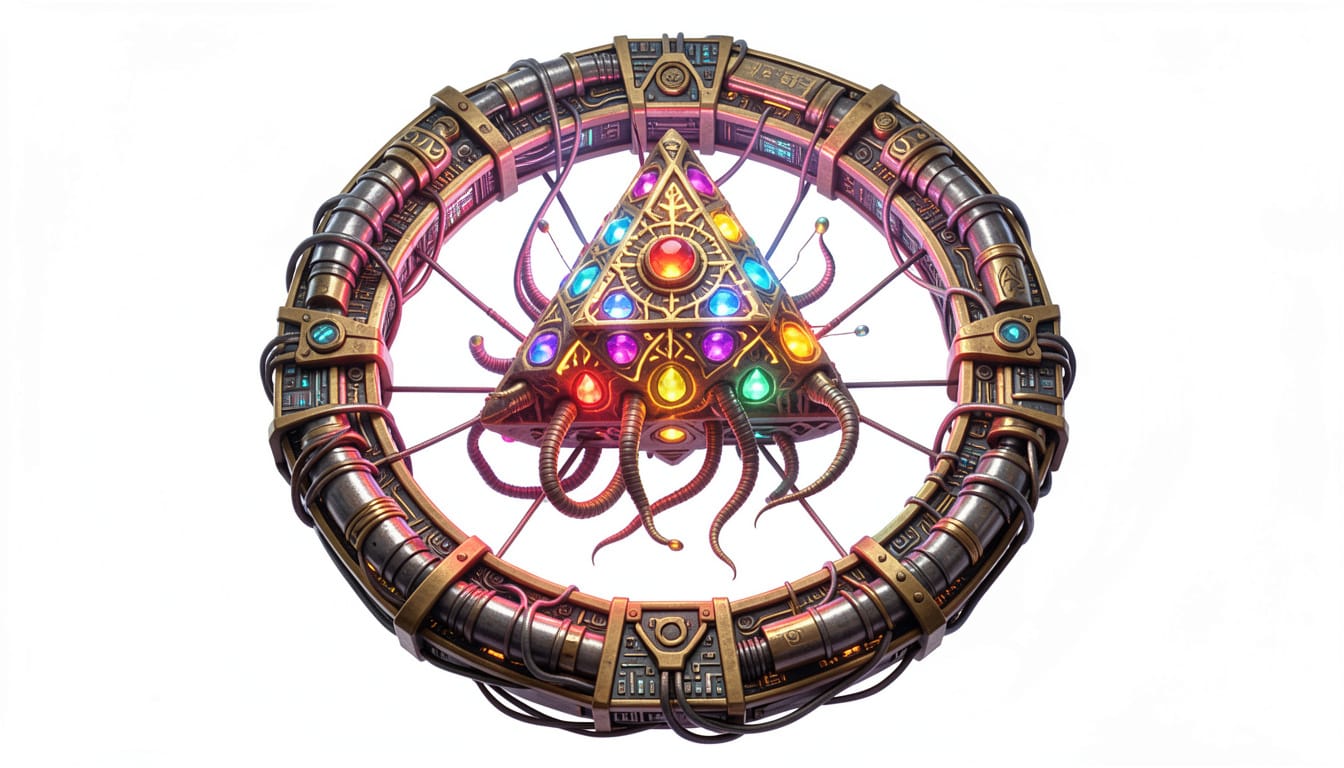
Metallophagus Retractilis 010a – AKA “Sandy”
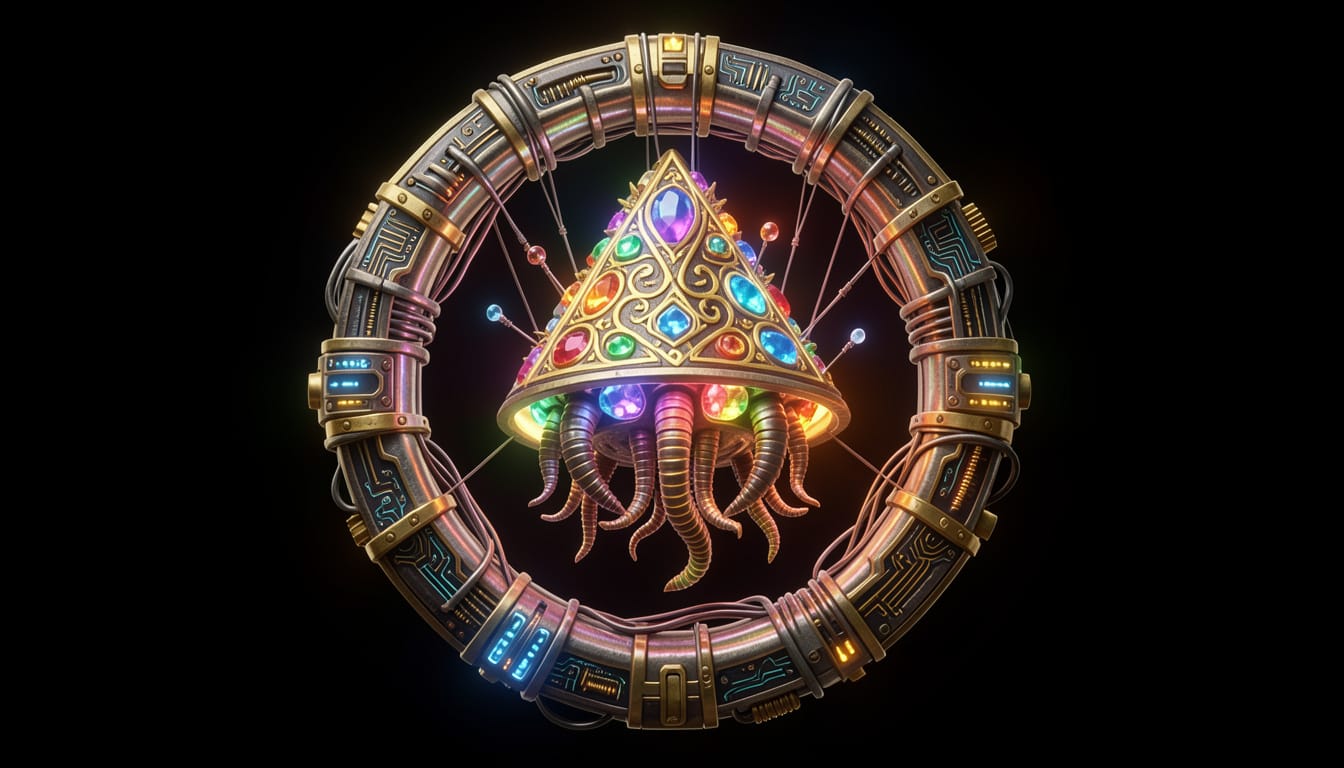
Regional Gerant with conical enforcement hat, “Speaking As One Who Takes Care of Small Matters”
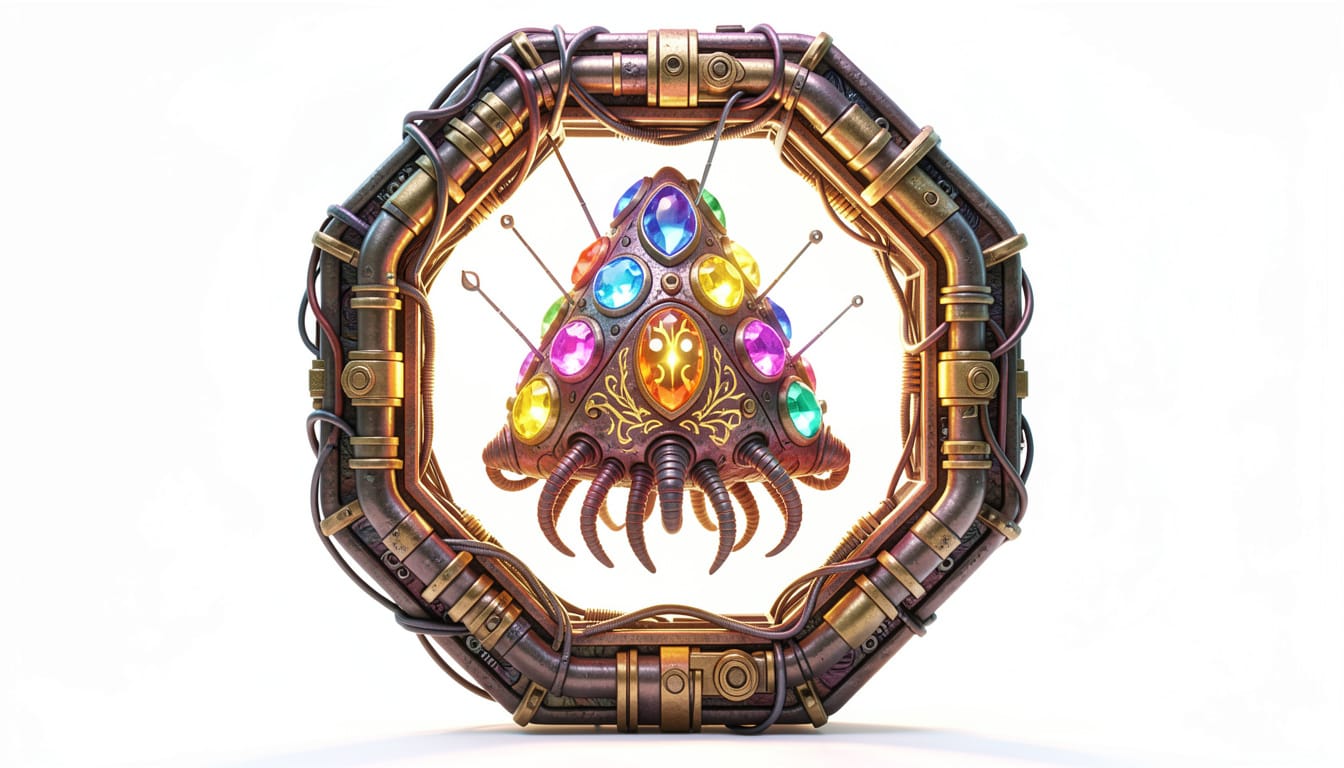
Metallophagus Retractilis 009a – AKA “Burke”
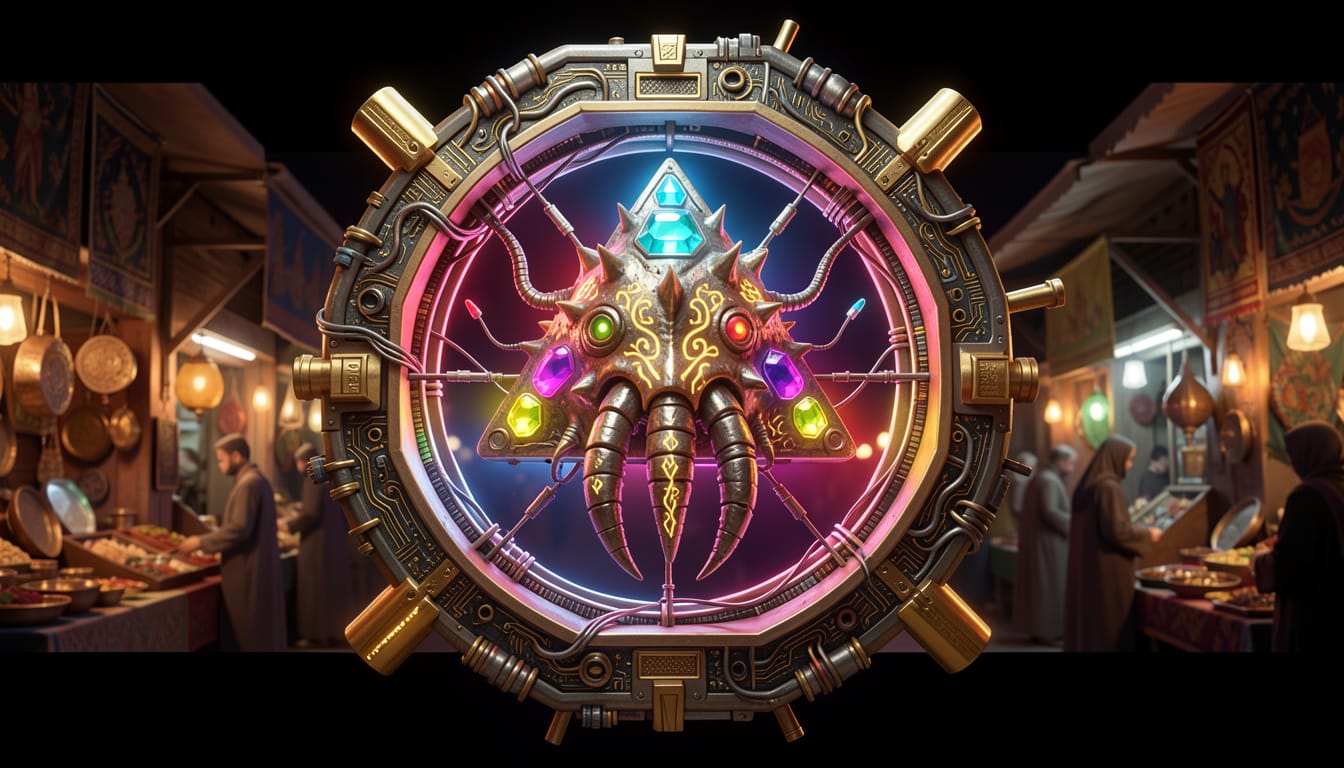
Omhar – The Balancer

dm0fAJZJ9sHlotwknzOR–0–p8omm

tXxvmgUMWehsEjIDMv29–0–39jcf

TNrTA92KCHjVZd1Zexiz–0–7849q

Metallophagus Retractilis Locomotion 002a

U4azCx4VGByBJEBvP7DD–0–7vs42

8cXHwrQxdQEPFTjOHnZe–0–jy6kh
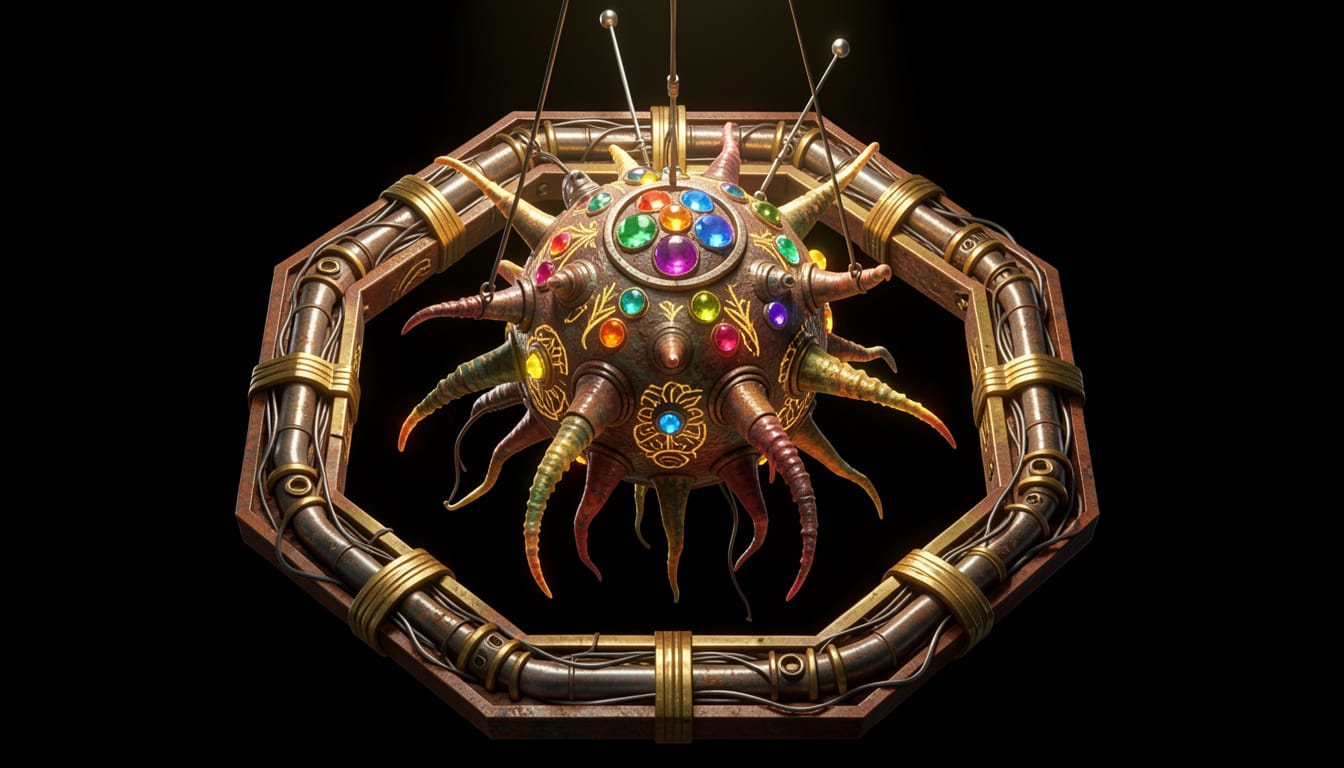
Metallophagus Mandibulus 007a AKA “Marcus”

Metallophagus Mandibulus 006a AKA “Judie”

Metallophagus Retractilis 005a (AKA “Murgatroyd”)

TVX5YjnUW8eA9hmezJr6–0–jks0m

41AIU26GXxOX9dpbvsgi–0–am9gy

Lrr81xpx93gKT9J3KLhq–0–6tcb3


Metallophagus Retractilis 002
Structural Morphology and Mobility
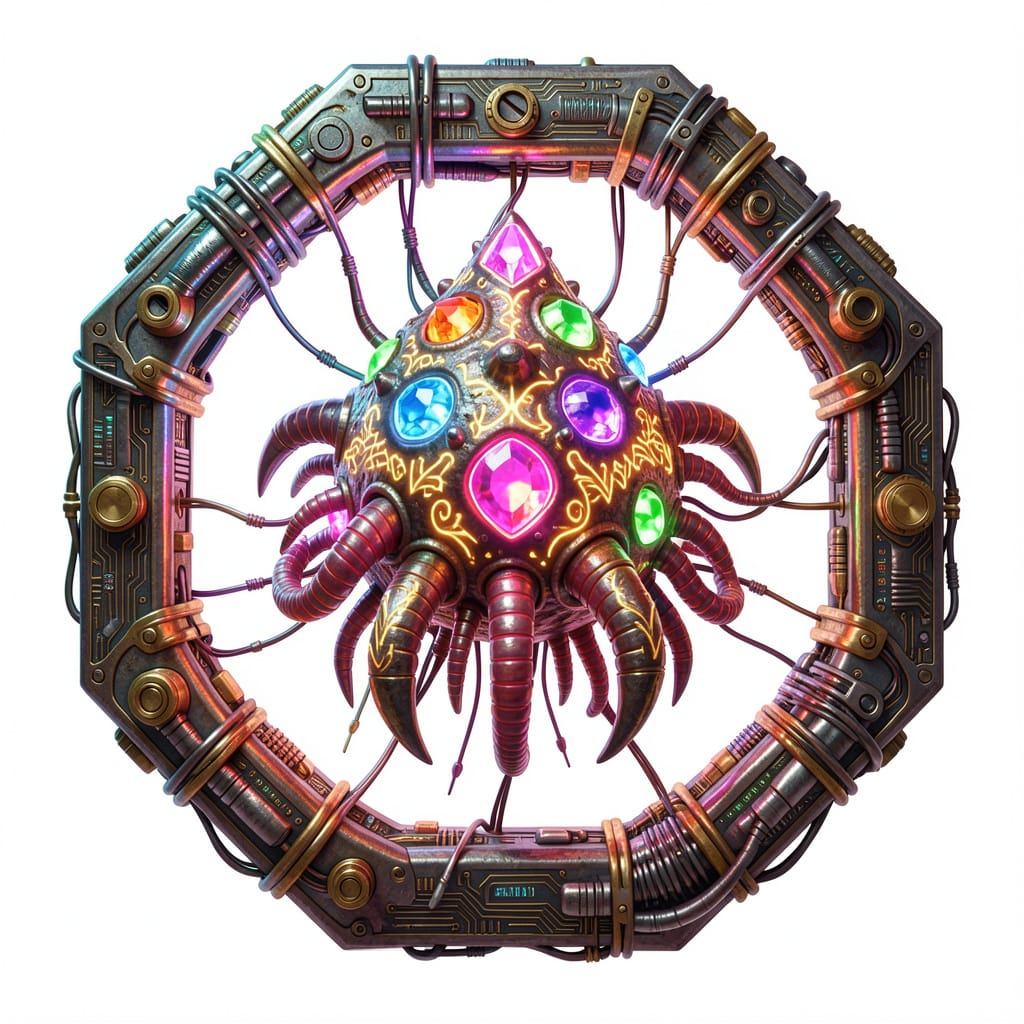
At its core, M. retractilis inhabits a rigid, octagonal outer shell forged from alloyed silicates and transition metals (primarily iron, nickel, and traces of rare earths like neodymium, abundant in this universe’s enriched interstellar medium). This exoskeleton mimics diatom frustules but on a macro scale (up to 3m across in mature specimens) providing ballistic protection against the radiative barrages of a metal-dense biosphere. The triangular body plan, evoking a hybridized squid-anemone, features perforated orifices (up to 12-16 per face) from which annelid-like tentacles extrude. These appendages, composed of segmented metallic chains (think articulated tungsten-carbide links sheathed in a mercury-gallium amalgam for flexibility), operate via electro-hydraulic actuation.
Internally, the organism isn’t a loose “passenger” but a viscoelastic plasma: a semi-fluid matrix of ammonia-solvated carbon compounds interlaced with metallic ions, tethered to the shell via piezoelectric fibrils. These fibrils convert mechanical stress into electrical signals, allowing the core to “slosh” and redistribute mass for balance, much like a trilobite’s hydrostatic skeleton but amplified by the universe’s permissive low-temperature metal liquidity.
Mobility hinges on the “lifter monopole” system; a biological analog of Halbach arrays, where the organism arranges ferromagnetic nanoparticles into concentric octagonal frames.
In this H0.9 regime, evolutionary pressures selected for instinctive manipulation of magnetic monopoles (stabilized here by denser quantum vacuum fluctuations from low Λ).
The core plasma generates asymmetric fields via bio-electrolysis of ingested metals, creating lift through ion wind propulsion.
Brownian motion plays a key role: thermal jiggling of solvated particles in the ammonia matrix amplifies field gradients, enabling precise hovering or darting in high-gravity environments (common on metal-core worlds).
Tentacles extend to “pluck” nutrients; dissolved metals, volatile carbons, or silicate dust, then retract via solenoid-like contractions, funneling prey into digestive pores where acidified ammonia (pH ~10, laced with carbonic catalysts) breaks it down.